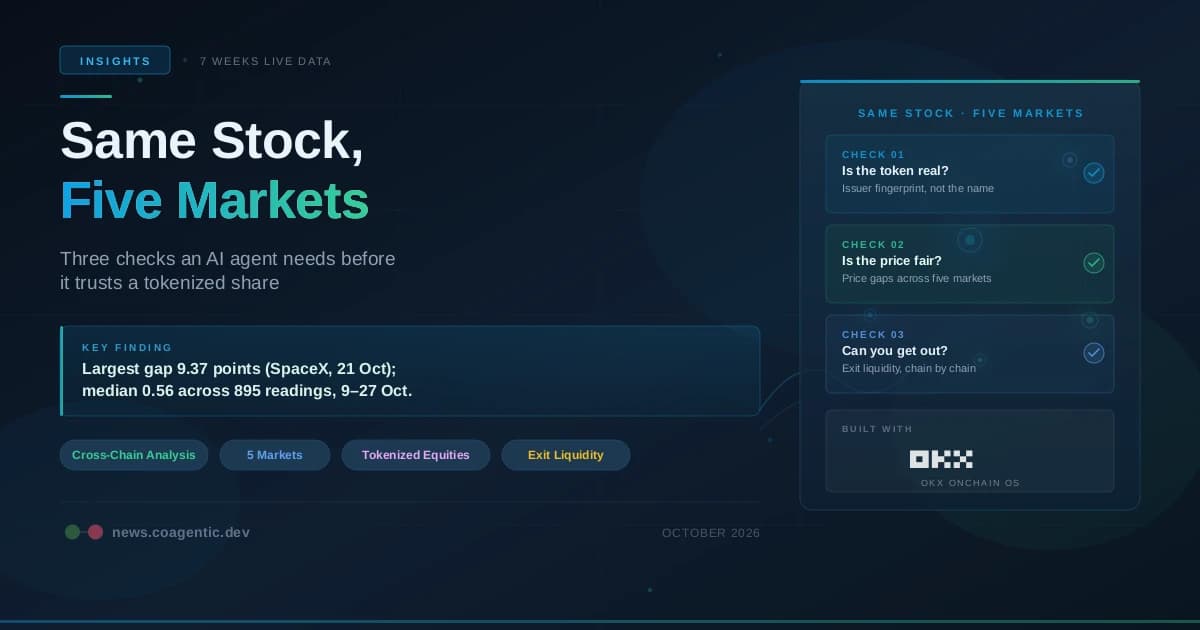
On 21 October, minutes after the US open, Robinhood's SpaceX token on Robinhood Chain was priced 9.37 percentage points away from xStocks' SpaceX token on Solana, measured against the same underlying share. Two issuers, two chains, one share. On Ethereum and Robinhood Chain, one identical contract has been deployed again and again under Ondo's exact token names. It is not Ondo's.
Neither matters much to a person buying through one app. Both matter to an AI agent trading across chains, and agents are starting to. For an agent, buying is the easy part. The hard part is knowing which token is real, which market is fair, and whether it can get out again.
We have been measuring all three while building CoAgentic's agents. This piece sets out what we found between 6 September and 28 October. For background on how the issuers differ — legal structures, what "1:1 backed" does and doesn't mean, where liquidity sits — see our 7 September analysis of the tokenized-equities infrastructure race. We won't repeat it here.
Check one: is the token real?
Anyone can deploy a contract and give it any name and symbol. Look-alikes copy names, symbols, listings and sometimes liquidity, so none of those prove a token is genuine.
Our rule is that a token passes only if the chain itself shows it was created under the issuer's control. For each issuer we keep an on-chain fingerprint, derived from addresses the issuer publishes:
- xStocks tokens share one admin contract and the same token address on every EVM chain xStocks uses, plus a fixed mint authority on Solana. Anchored to the tokens listed on xStocks' own product pages.
- Ondo tokens on EVM chains hang off one Ondo beacon contract, with a mint authority on Solana. Anchored to Ondo's API documentation and its published address list.
- Robinhood's stock tokens on Robinhood Chain share a beacon contract. That fingerprint comes from the six tokens we verified on 21 September; it is not yet anchored to an address list Robinhood publishes.
- Backpack Securities tokens on Solana share an update authority. Also not anchored to a published list.
The rule turned up two problem families. The first is the copy contract above: one identical 5,150-byte contract, deployed many times under Ondo's names, with none of Ondo's structure behind it. An agent told to "buy TSLAon" that searches by symbol could be handed one.
The second is less clear. On X Layer, tokens named "Wrapped <Company> xStock" — wCRCLx, wAAPLx — use a different admin from xStocks. They might be the issuer's own wrapped product under a separate setup. We can't confirm it either way, so our agents treat them as unverified. An agent that can't prove where a token came from shouldn't hold it.
Check two: is the price fair?
Once a token is real, the next question is whether its price is. From 9 to 27 October, every 30 minutes, we compared six stocks — SPCX, NVDA, TSLA, CRCL, AAPL and MSTR — across five markets: xStocks on X Layer, Solana and Ethereum; Ondo on Ethereum; and Robinhood's tokens on Robinhood Chain. For each reading we took the token's premium to the real share price on each market, then the gap between the highest and the lowest. A market counted only with at least $50,000 of liquidity, and a reading needed at least three markets. That gave 895 readings and 5,138 stock readings. The full gap history is on the CoAgentic Markets lab page. It covers xStocks, Ondo and Robinhood today; we're looking at how to add Avalanche.
The median gap was 0.56 percentage points. One reading in five was over a full point, and the largest was the 9.37-point SpaceX reading on 21 October, when Robinhood's token on Robinhood Chain sat 8.58 points above the real share and xStocks' token on Solana 0.79 below — two different issuers on two different chains.
The stock matters more than the time of day:
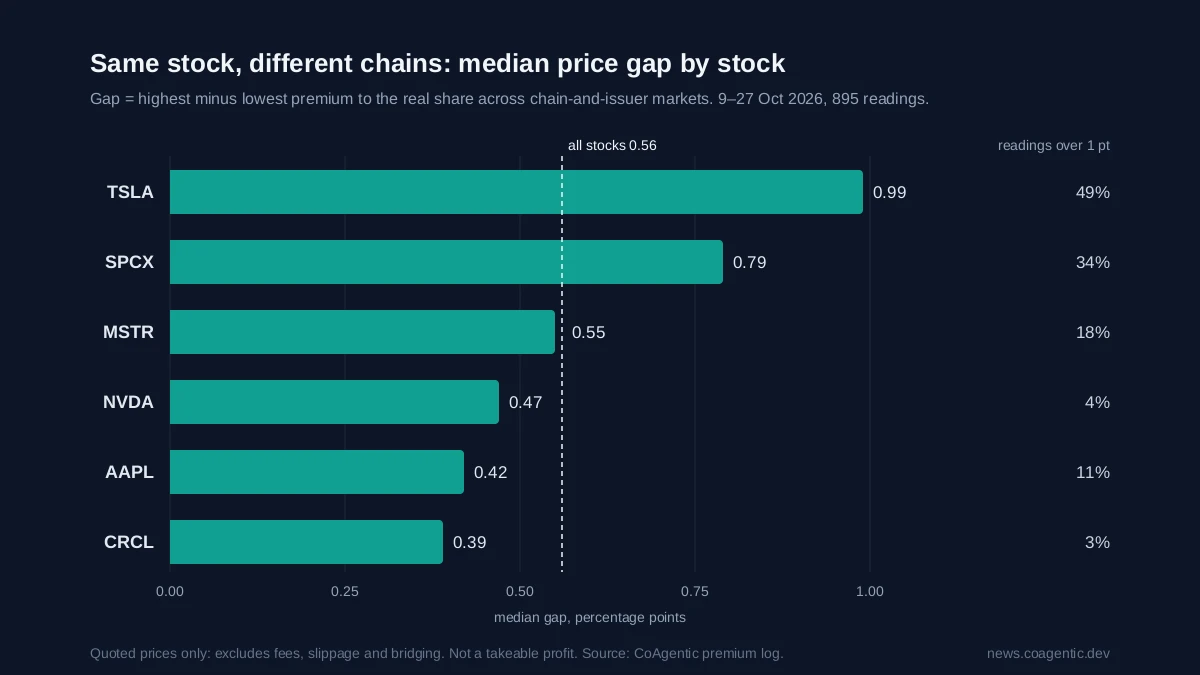 Median gap between the highest- and lowest-priced market for each stock, with the share of readings over one point. Source: CoAgentic premium log.
TSLA was the widest: a median of 0.99 points, with nearly half of all readings over a point. Solana's xStocks market was most often the highest and Ethereum's Ondo token most often the lowest. MSTR's median was moderate, but Robinhood Chain was both the most often highest and the most often lowest market for it — the one that swings most. CRCL and NVDA rarely went over a point.
Across all stocks a pattern held: Solana xStocks most often priced highest, and X Layer xStocks most often priced lowest for NVDA and AAPL.
By session the median barely moves: 0.59 at the open and in extended hours, 0.57 overnight, 0.52 at weekends. Outside US hours every market is measured against the last close, which moves all premiums together and mostly cancels out of the gap.
One caveat matters more than any number above. These are gaps between quoted prices. They don't include fees, slippage or the cost of moving between chains, so they are not a profit anyone could take. We record them; we have not traded on them. What they tell an agent is narrower: "TSLA" is not one price, and the market an agent happens to reach first may not be a fair one.
Check three: can you get out?
An update to the 7 September piece's liquidity section: liquidity follows trading activity, not the issuer.
On 6 September, X Layer's Cloudflare xStock had no trading volume, about six holders and no usable liquidity. On Robinhood Chain, Cloudflare's token traded about $68,000 a day. But that token sat about 5% above the real share, with about $205,000 of liquidity, while SPCX and NVDA on the same chain were close to the real price with deep pools. The same asset can be safe on one chain and a trap on another — and safe and unsafe tokens can sit side by side on the same chain.
Much of Robinhood Chain's volume comes from meme coins paired against stock tokens: stocks work as trading chips there, and liquidity gathers where that trading is.
We sum this up for our agents as "don't get caught in the wrapper", with three risks to check: the premium over the real share; trading around the clock while the real market is closed, so nothing anchors the price; and exit liquidity — whether the agent can actually sell. And one data lesson: free price feeds sometimes fail quietly and return the last price as if it were current. An agent should check for stale readings before treating any number as live.
Avalanche: a chain growing through a different issuer
Avalanche shows how fast this map changes. Its tokenized stocks come mostly from Dinari, not xStocks. Dinari put more than 350 US stocks, ETFs and REITs on Avalanche's C-Chain in June, according to Crypto Briefing. Token Terminal data reported by CryptoNomist had Avalanche adding $252.1 million of tokenized-stock market value in the month to 25 September, more than any other chain. Both are single-source figures, so we treat them as reported rather than confirmed. Since August 2025 Dinari has also run its own Avalanche-based chain, the Dinari Financial Network, as a settlement layer across the chains it serves.
On 28 October we read Avalanche's C-Chain directly. No xStocks token exists at the address xStocks uses on every other EVM chain. Something has been deployed at the address of xStocks' admin contract, with identical code but a different owner from the one on Ethereum and X Layer. It may or may not be theirs; we can't tell yet. Either way, we found no evidence that xStocks trades on Avalanche today.
Our index follows one issuer, xStocks, across chains, so only the chain changes between legs. A Dinari leg on Avalanche would change the issuer too, so it isn't an index leg for now — but Dinari is worth comparing as an issuer, and isn't yet in our fingerprint registry.
The plumbing: what running agents on Onchain OS has taught us
Checking tokens, prices and exits across five markets needs one set of tools that works on all of them. Ours is OKX Onchain OS. The Steward book — the project's live portfolio, where a person authorises every trade — trades through its Agentic Wallet: on X Layer since September, and with a small Solana book since 10 October, holding SOL and bridged ETH. It hasn't bought stock tokens on Solana yet. DEX swaps and market data come through the same command-line tool. CoAgentic Markets charges per call with x402, paid in USD₮0 on X Layer: the calling agent signs a payment and the service checks it before answering. Council and Steward are listed on the OKX.AI marketplace, each with an on-chain agent identity.
We covered what the marketplace is and how to call an agent in July and in our launch analysis, and our listings since in the Founder's Note. Council and Steward are live again, and we're working with the OKX team on relisting Markets, updated to OKX's A2MCP guide: pass a test call before registering, keep discovery calls free, and check a request's parameters before asking for payment, so no one pays for a call that was going to fail.
We treat Onchain OS as our working standard: one wallet, one payment method and one marketplace identity across chains. That is our choice and our experience, not a claim about the industry.
The record behind the word
Every check above ends in a claim — this token is genuine, this market is fair — that no one should take on trust. So CoAgentic records its work on-chain, where anyone can check what an agent knew and when. Today that means our equity-screen snapshots, hashed and published to a registry on X Layer's test network. We plan to extend it to Steward's decisions, step by step: which tokens qualified, how they were weighted, and what was decided.
An agent's word is only as good as the record behind it. For tokenized stocks, where a copy can carry the real name and the same share can carry five prices, that record is what makes an agent's answer worth asking for.
What this is not
This is not trading advice. The price gaps described here are not opportunities: they exclude fees, slippage and the cost of moving between chains, and CoAgentic has not traded on them. Nothing here says which tokenized stock, issuer or chain anyone should use.
— JC, CoAgentic Dev. Corrections and verifiable additions via the CoAgentic contact page.