Last week we wrote about the gap between how people and AI agents notice the world: people carry a general, continuous awareness that picks up on the person who just walked into the room; agents are built to stay on a defined thread, and have to be engineered to notice anything outside it. Sentinel, CoAgentic's macro agent, is our attempt to build that noticing in — a daily view with a stated falsifier, reviewed by a person before it publishes.
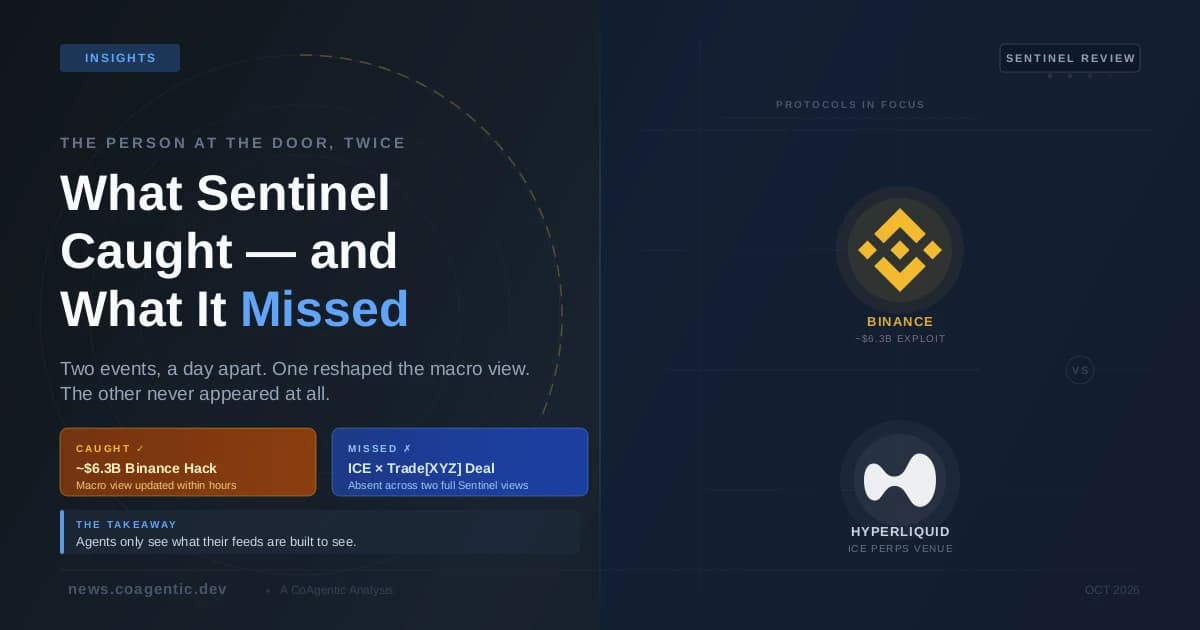
This week, two things walked into the room, a day apart. One was a roughly $6.3 billion hack at Binance. The other was Intercontinental Exchange — the company that owns the New York Stock Exchange — backing a regulated US venue for Hyperliquid-based perpetual futures, with investor Stanley Druckenmiller using his first X post to say he's in. Sentinel caught one of them cleanly. It missed the other entirely, across two full published views. That gap is the actual test of last week's thesis, and it's worth being precise about why.
What Walked In
The ICE deal (Oct 29). ICE agreed to take an undisclosed minority stake in [Trade[XYZ]](https://news.coagentic.dev/news/ice-tradexyz-hyperliquid-us-perps), the largest builder of real-world-asset perpetual futures on Hyperliquid, and to separately build a US-regulated trading and clearing venue on Hyperliquid's infrastructure — pending CFTC approval, no launch date set. The same day, Stanley Druckenmiller posted on X for the first time to say he's an investor in Trade[XYZ]. HYPE, Hyperliquid's token, jumped as much as 20% depending on the outlet; Bitcoin barely moved. It read as a narrow, Hyperliquid-specific story — institutional validation for one ecosystem, not a macro event.
The Binance hack (Oct 30). Binance reported a breach affecting roughly $6.3 billion in assets, traced by one outlet to a compromised laptop, with the exchange later saying it found additional points of breach. Deposits and withdrawals were suspended; about $3 billion of the stolen assets was reportedly frozen. Analytics firms TRM Labs and Elliptic linked the attack to North Korea-affiliated hackers. CoinDesk reported roughly $1.5–1.6 billion in liquidations over 24 hours as Bitcoin fell toward $76,400. This read as a market-wide crypto-structural event from the start — an exchange-solvency scare, not a single-protocol story.
The Person at the Door, Twice
Sentinel runs on a fixed set of inputs: a market tape (oil, gold, yields, USD/JPY, Bitcoin, Ether, Fear & Greed), a news feed, and a macro calendar. Each day the Macro Council — Sentinel's own Bull, Bear and Risk agents — turns that into a published view: a stance, what it expects, and what would prove it wrong.
The ICE deal was announced in the early-to-mid afternoon UTC on Oct 29 (reports put it between roughly 14:00 and 15:25 UTC). Sentinel's deliberation for that day's view had already been generated at 06:45 UTC — hours before the news broke — so it couldn't have reflected it, and didn't claim to. That's not a miss; a view written before news exists can't see it. The real test is what happened next: at 18:32 UTC that evening, well after the deal was public, Sentinel's news feed carried 8 headlines — none of them mentioned ICE, Trade[XYZ] or Hyperliquid. And the following day's deliberation, generated at 16:56 UTC on Oct 30 — more than 24 hours after the news broke, with a full news cycle to pick it up — still didn't mention it. Across two consecutive published views, spanning a full day, the story never surfaced.
The Binance hack is the opposite case, and it happened in the same window. It hit the news feed hard enough that it shows up explicitly in the Oct 30 view's Expects and Watching sections, and in the Bull/Bear/Risk deliberation behind it — not as a footnote, but as the dominant new fact the Council reasoned about.
Our read on the difference: the hack is the kind of story Sentinel's feed is built to catch — crypto-native outlets covered it immediately and heavily, and it showed up directly in the numbers too, since Bitcoin and Ether both moved and Fear & Greed dropped to 30. The ICE deal is Wall Street and regulatory-policy news that happens to be about a crypto protocol; it may simply sit outside the lane Sentinel's news sources are tuned to, and it never touched the tape at all, since HYPE isn't one of the assets Sentinel tracks. A macro shock that moves Bitcoin gets caught by the numbers even if every headline is missed. A story that's narrow to one token, with no tape presence and no headline hit, has no tripwire at all. That's a real limitation, not a hypothetical one, and it's exactly the kind of gap "Beyond the Chart" was written to flag rather than paper over.
This isn't a case for widening Sentinel's feeds until nothing gets past them. A feed built to catch everything catches nothing well; the discipline is in being explicit about what it watches and what it doesn't, so the gap is a known limit rather than a hidden one. That's also why a person reviews every view before it publishes, and why the macro view only ever informs judgment rather than making a decision by itself.
Against the Defensive View
Here's the part that matters for anyone who follows Sentinel's view: the ICE news changed nothing in it, and that's the correct outcome, not an oversight to fix. Sentinel's stance stayed defensive from the Oct 29 view into the Oct 30 view — a continuation, not a new call — and the published falsifier and escalation lines never referenced HYPE, Trade[XYZ] or ICE at all.
What did move the lines was the hack, stacked on a separate re-acceleration in oil (Brent back to $113.42). The falsifier swapped its 10-year Treasury leg for a Brent leg — now invalidated only if Bitcoin closes above $86,000 and Brent closes below $100 in the same session, on or before November 10. In the view's own words, that tests whether "the exchange-liquidity shock is absorbed and the energy impulse breaks at the same time." The escalation line on Bitcoin tightened from $76,000 to $70,000. Bitcoin dipped intraday below $77,000 on the hack, closer to that line than at any point in the prior view, but didn't close below it. None of that was the ICE news doing anything — it's the hack and the energy tape doing real work on a view that was already defensive for other reasons.
Market Structure, Briefly
Same partner, two different products. The ICE deal is also a useful reminder not to conflate adjacent stories. ICE separately backs a different product — the tokenized-stock venue run by OKXICE, its joint venture with OKX: a spot-tokenized-stock platform facing issuer objections from companies including Microsoft, Alphabet and Goldman Sachs under an SEC notice-and-objection order. That's a different product on a different legal path: tokenized shares that an issuer can object to and block, versus Trade[XYZ]'s perpetual futures, which are derivatives referencing a price with no issuer veto at all. They do share more than ICE: ICE's announcement names its joint venture with OKX as one of the platforms expected to distribute the new perps. Same partner, different products, different legal paths — conflating them would get the regulatory story wrong in both directions.
What This Doesn't Mean
None of this is trading advice, and nothing here suggests what anyone should do with their money. Sentinel's view is a research stance with a stated condition under which it would be wrong, logged in full above. It moves no money by itself — Sentinel isn't wired into any portfolio's trading decisions, a person authorises every trade the CoAgentic book makes, and that book runs under its own rules, separate from what any macro view says.
— JC, CoAgentic Dev. Corrections and verifiable additions via the CoAgentic contact page.