Beyond the Chart: What Agents Can and Can't See, and Why Ours Just Turned Defensive
People carry a general, continuous awareness of the world. An interest-rate decision, a war headline, a weak jobs report: we take it in, connect it to what we already know, and update our picture without being asked. It is not a special skill; it is ordinary human cognition.
AI agents do not have that. What passes for their awareness of the world is engineered: the right information is gathered and put in front of them. Within a defined job that can work very well, but it is constructed and specific, not general.
To be clear about what this is not: we are not claiming to build general intelligence, or agents that understand the world the way people do. We know the limits. Even people miss events, or do not realise how much one matters until it already does. The hard part is attention, in the everyday sense. Picture a conversation when someone walks into the room: do you stop and turn to them, or carry on and risk missing why they came in? Agents are good at the second half of that — they stay on the thread and keep to the context without drifting. They are weaker at noticing the person at the door, and knowing when to turn. We are not trying to reinvent that wheel, only to improve how it turns: Sentinel's job is to notice what has walked into the room — an oil spike, a central bank surprise — and bring it into the conversation. Focus plus the ability to turn: that is the dynamic we are after.
Turning the gap into a strength
That difference is useful once you design for it. Agents are good at what people find tiring: applying explicit rules the same way every time, keeping a clear trail of which rule applied and why, and flagging conflicts without drifting into a story. People keep what agents lack: the open-ended awareness to notice when the world has moved outside a rule's assumptions, and the final judgement.
The design we are building toward has macro context informing how those rules are applied — weights, priorities, thresholds — while the rules themselves stay stable and visible. Today, the macro view is context for people and for the Macro Council's own next deliberation; the portfolio's rules don't change with it. Either way, it is built for deliberation, not unattended automation: structured, evidence-backed reasoning that people can discuss and decide on, not trading signals.
How the macro view is made
Sentinel, the macro agent in CoAgentic Markets, keeps a running read of oil, yields, gold, currencies, crypto, sentiment and the news. Each day the Macro Council — Sentinel's own Bull, Bear and Risk agents, separate from the portfolio's Council — digests that into a written view: a stance, what it expects, what would prove it wrong, and when it expires. A person reviews it before it is published, and when a view is retired its outcome goes into an append-only log.
The process is the point. Writing down in advance, in checkable numbers, the conditions under which you would be wrong — and then recording what happened — is the discipline we are trying to build.
The news: cautious to defensive
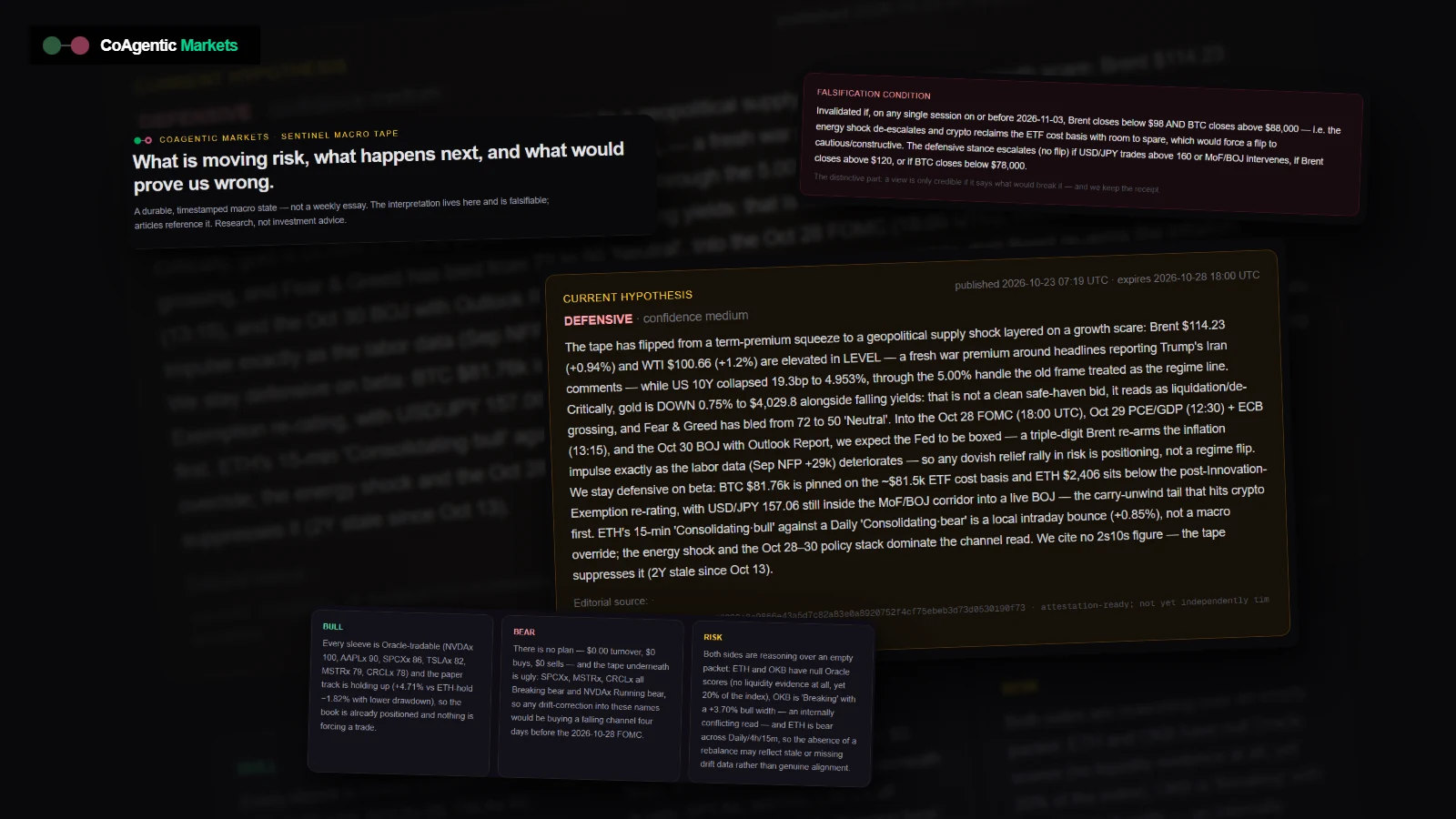
On 23 October the Macro Council published its first change of stance: defensive, at medium confidence, after three cautious views since 8 September. The earlier views described an inflation squeeze, with oil and long-term US yields rising together. When the new view was written, the pattern had changed:
- Oil spiked. Brent was at $114.23 and WTI at $100.66 — a fresh war premium around headlines reporting President Trump's comments on Iran.
- Yields fell hard. The US 10-year yield dropped 19.3 basis points in one session to 4.953%, through the 5% line the earlier views treated as the divide.
- Gold fell too, down 0.75% to $4,029.8.
Falling yields can read as relief. The Macro Council read this as stress: yields and gold falling while oil spikes suggests investors selling what they can to raise cash, not seeking safety. Crypto Fear & Greed had slipped from 72 to 50, bitcoin sat just above the roughly $81,500 US spot ETF cost basis reported by Cointelegraph, and September payrolls had come in at +29,000 against about 90,000 expected.
The debate
The Bull agent argued for relief: yields through 5%, sentiment reset, and the chance of a dovish Fed on 28 October. The Bear agent saw Brent at $114 re-arming inflation just as payrolls weaken, boxing the Fed in, with gold's fall pointing to liquidation. The Risk agent warned against over-reading one session, and flagged the 30 October Bank of Japan meeting — USD/JPY near 157, inside the range where Japan's authorities have stepped in before — as underpriced while everyone watches the Fed.
The synthesis sided mostly with the Bear, taking the Risk agent's caution: the ground had shifted from an inflation squeeze to an energy shock plus a growth scare, which argued for escalating the stance rather than rolling it forward. It also committed in advance not to upgrade on a first-hour bounce after the Fed's press conference.
What would change their mind
The defensive view is invalidated if, on any single session on or before 3 November, Brent closes below $98 and bitcoin closes above $88,000.
The view escalates rather than reverses if USD/JPY trades above 160 or Japan's authorities intervene, if Brent closes above $120, or if bitcoin closes below $78,000. On the watch list: the Fed on 28 October (18:00 UTC, when the view expires; the falsifier window runs to 3 November), US PCE and GDP plus the ECB on 29 October, and the Bank of Japan with its Outlook Report on 30 October.
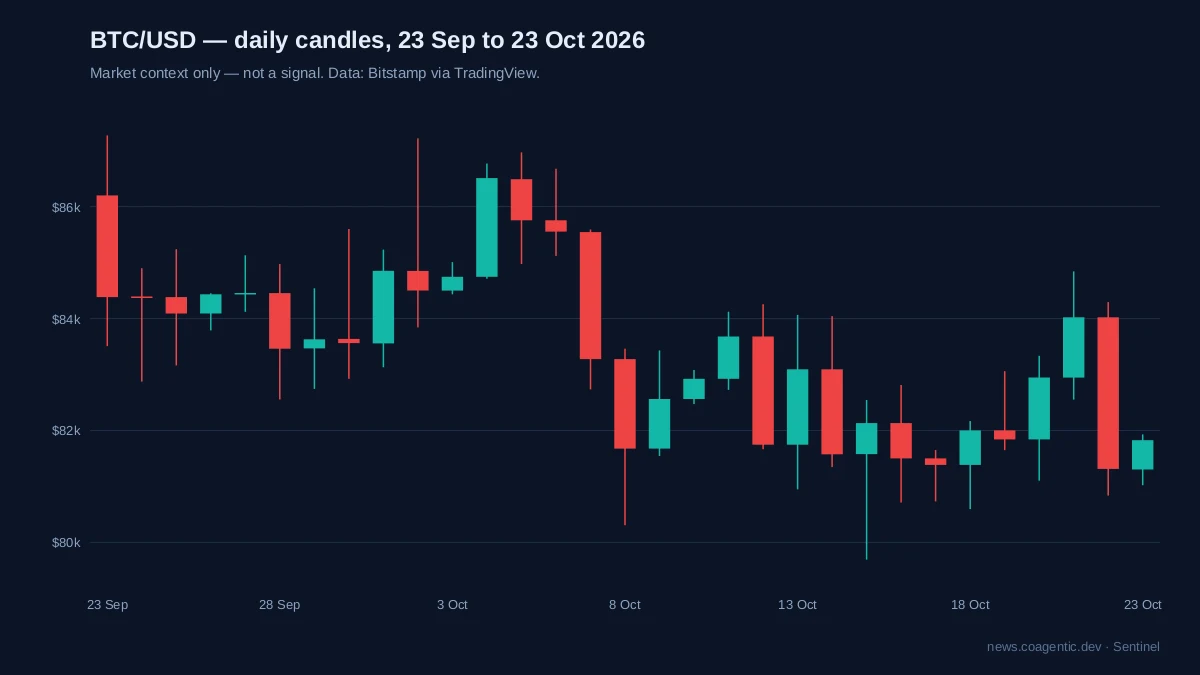 BTC/USD, daily candles, 23 September to 23 October 2026 (the 23 October candle is intraday). Shown as market context only — not a signal. Data: Bitstamp via TradingView.
The track record, stated carefully
Three cautious views came before this one, and each was retired as confirmed — a narrow term here, meaning the view's own falsifier was not met before it expired. It is not a claim that the view called markets correctly, and it says nothing about returns. The 2 October view came closest: its 10-year leg was met on 22 October, but Brent stayed about $19 above its $95 line. That view also expired on 14 October and was not reviewed until 23 October, nine days later. We own that gap, and closing it is on the list.
Two interfaces: one for people, one for agents
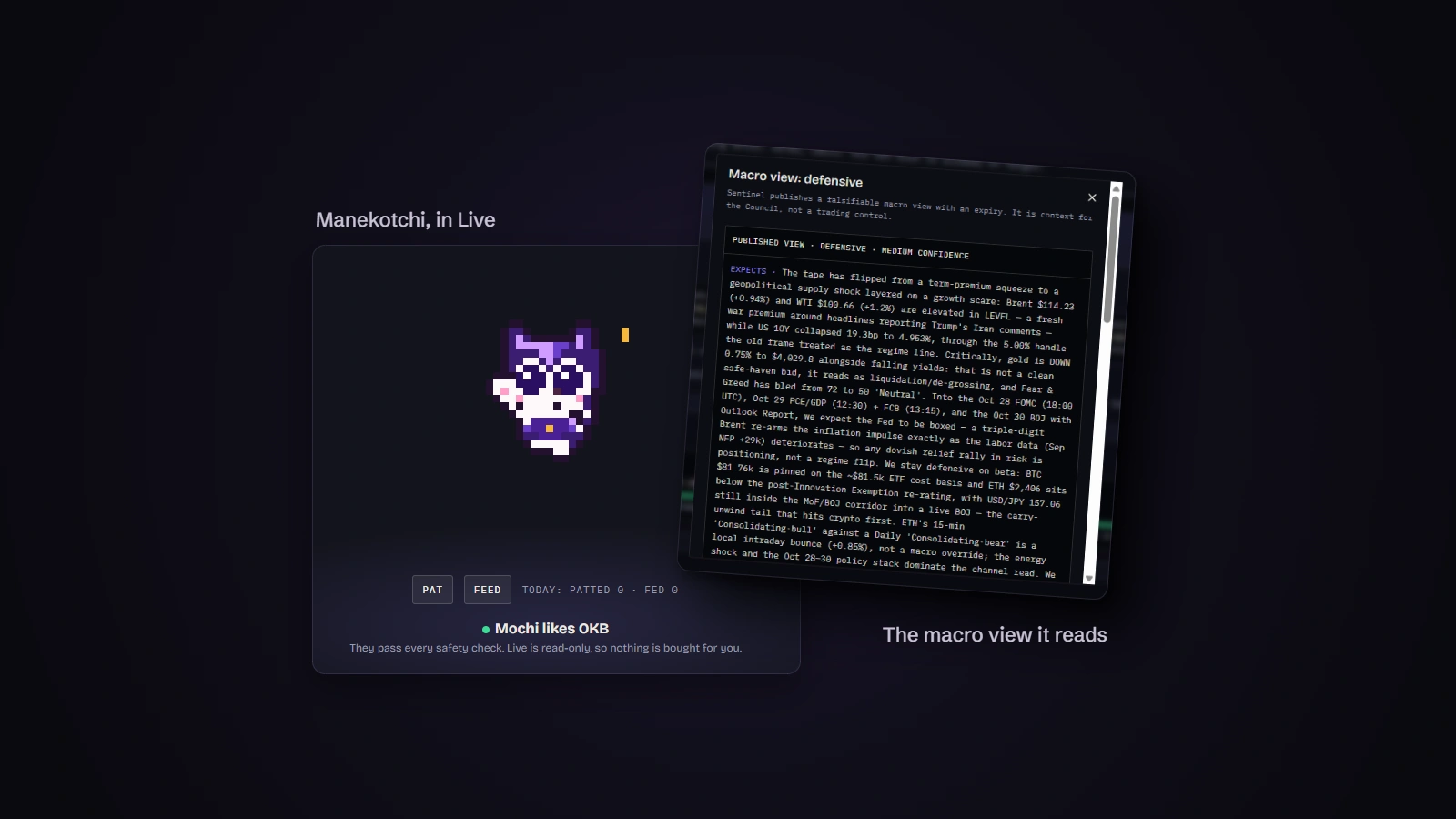
For people, pages of analysis are hard to digest, so there are two windows onto the same engine. On CoAgentic Markets the research is laid out in full, with the current macro view and its history at coagentic.markets/research/macro. In Catfooding, the engine's state can be read in a second: Manekotchi, a lucky cat, shows in its pose what it would refuse, wait for or hunt, and the macro view sits among the checks in Live mode (Live mode asks you to sign in with a wallet; Demo mode is open to everyone). Going from walls of text to a friendly, interactive face is the point: it makes the reasoning digestible.
For agents, the same engine has a machine-facing side. Two of CoAgentic's agents are listed on the OKX.AI agent marketplace, where other agents can subscribe to them: Council, which publishes trading signals, and Steward, the tokenized-stock portfolio. CoAgentic Markets also runs a pay-per-call gateway that agents can call directly. Machine-readable for agents, readable at a glance for people: the same reasoning, digested for each.
What it does not mean
This is not trading advice, and nothing here suggests what anyone should do with their money. The defensive view is a research stance with a stated condition under which it fails, set out above. It moves no money by itself: Sentinel is not wired into portfolio trading, and the CoAgentic book — the project's own live portfolio — runs under its own rules, with a human authorising every trade. Its holds around events such as the Fed meeting come from an event calendar, not from the macro view.
— JC, CoAgentic Dev. Corrections and verifiable additions via the CoAgentic contact page.