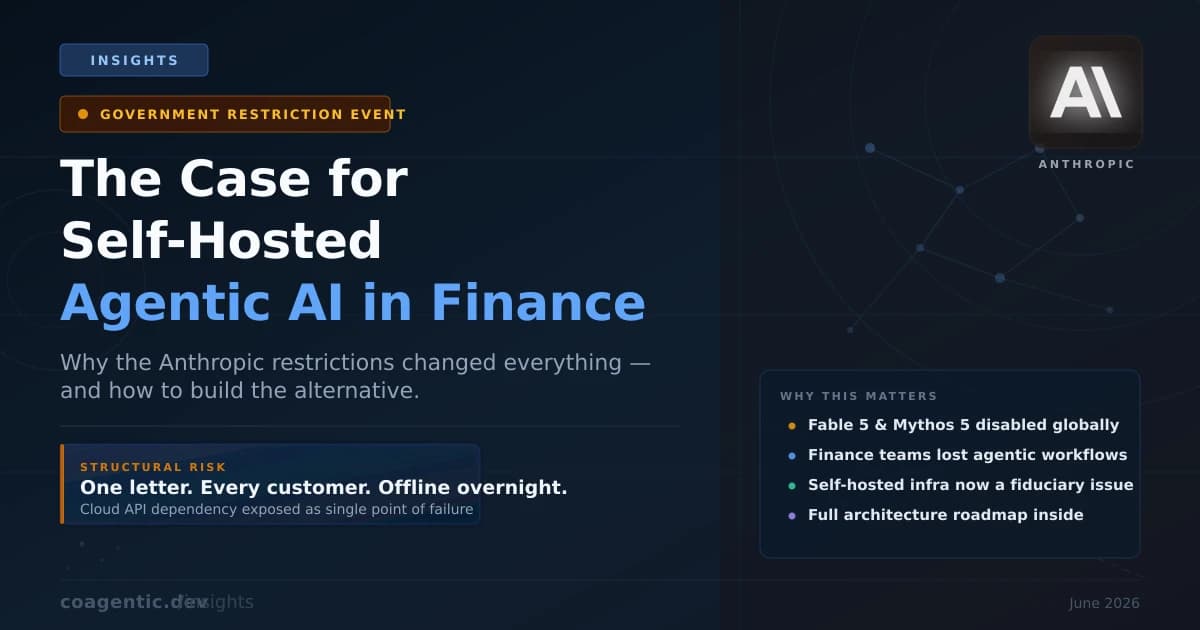
The Dependency That June 12 Made Visible
Export controls and data residency requirements are colliding with the rapid adoption of agentic AI in finance. On June 12, 2026, Anthropic was forced to disable two of its most advanced models globally following a U.S. government directive. While the full details and long-term implications are still emerging, the incident highlighted a structural risk that many finance teams have under-appreciated: building critical agentic workflows on infrastructure they do not control.
The directive required Anthropic to suspend all access for "any foreign national, whether inside or outside the United States, including foreign national Anthropic employees," according to Anthropic's official statement. In Anthropic's own words: "we must abruptly disable Fable 5 and Mythos 5 for all our customers to ensure compliance." Three days after launch. Every customer. One letter.
The same day, SpaceX raised $75B in the largest IPO in history — a company that owns its physical infrastructure and answers to no single API endpoint. We covered that contrast in our SpaceX IPO and physical AI infrastructure piece. This article is about what finance teams should do about it.
The structural case for self-hosted AI in finance predates June 12. That date made it undeniable.
The Dependency Problem Finance Teams Built Into Their Stacks
For companies that embedded cloud AI in internal tools or autonomous agents, June 12 created an immediate compliance problem: every system routing prompts to an export-controlled model — including those accessed by foreign national employees — requires assessment. That is not a hypothetical. That is how most enterprise AI stacks were built.
For regulated use cases involving non-public data, proprietary positions, or regulatory submissions, routing that data through an external API is often a disqualifying constraint before any government directive enters the picture.
Four dependency risks compound here:
Contractual access risk. These issues create significant compliance obligations, not just if Fable 5 access is restored, but also for adoption of any future frontier model that may be determined to present national security concerns. There is no contractual protection against a government directive.
Data leaving the perimeter. Every prompt sent to OpenAI, Anthropic, or Google touches external infrastructure you do not control. For regulated financial workloads, that is often a disqualifying constraint independent of any government action.
Cost at scale. Self-hosting becomes cost-effective at approximately 2 million tokens per day — a rough industry estimate that varies by model size, hardware, and provider pricing — below that threshold, API costs are typically lower than infrastructure overhead. Agentic financial workloads — with multi-step reasoning loops, tool calls, and document-heavy RAG pipelines — routinely exceed that threshold.
Single-vendor concentration risk. Cloud API convenience comes with trade-offs: vendor lock-in, limited customization, unpredictable pricing and performance, and ongoing concerns about data privacy. June 12 added a fourth: regulatory risk you cannot model, from a government whose next action you cannot predict.
What Self-Hosting Actually Means in Practice
Self-hosting is not "run a model on your laptop." It is a four-layer stack. Here is how each layer works and why it matters for finance teams.
Inference layer — where the model actually runs
Ollama is the fastest way to get an open-source LLM running locally. One command to install, one command to run. It handles model downloads, quantization, GPU memory management, and exposes both a CLI and an OpenAI-compatible REST API. Use it for local development and prototyping — low barrier, no ongoing cloud cost.
For multi-user production serving, vLLM is the clear choice: continuous batching, OpenAI-compatible API, tensor parallelism, and predictable throughput under load.
Hybrid environments sometimes run both — Ollama for dev/staging, vLLM for prod — to keep iteration speed high without sacrificing production throughput.
Once you have a reliable inference backend, the next decision is which model to run on it.
Model layer — what you run
Qwen3-235B-A22B is a Mixture-of-Experts model with 235B total parameters and 22B activated. It supports switchable thinking mode for reasoning-intensive tasks and standard mode for general dialogue, native MCP tool-calling, and is released under Apache 2.0.
Alternatives worth evaluating: Llama 4 Scout (strong long-context), Mistral Small 4 (reliable function calling and JSON output), DeepSeek R1 (reasoning-focused, efficient MoE).
Interface layer — human oversight and multi-user access
LibreChat and Open WebUI both expose OpenAI-compatible backends in a multi-user interface, support MCP tool connections, and provide the oversight layer that agentic financial workloads require. Human approval queues can be surfaced here. When an agent proposes an action — a trade, a rebalance, a governance vote — the interface layer is where a human sees it before execution.
Orchestration layer — how agents coordinate
MCP has become the de facto tool-calling standard for major agentic AI frameworks — LangChain, LlamaIndex, Microsoft AutoGen, and CrewAI. For finance-specific MCP server patterns, this architecture is particularly relevant for firms involved in quantitative analysis, risk modeling, and AI-driven financial advisory tools, where data accuracy and speed are critical.
The practical pattern for agentic finance: LangGraph or CrewAI for multi-step agent orchestration, MCP servers for tool access (market data, on-chain feeds, internal databases), and vLLM serving the model entirely within your perimeter.
The Hybrid Pattern: Not Binary
Most finance teams will not, and should not, move everything local overnight. The right architecture is not "all cloud" or "all self-hosted." It is deliberate routing.
A common production pattern is intelligent routing: use a fast, cheap open model (7–14B, self-hosted or on Groq) for 80% of requests, and escalate to a frontier closed model for the 20% that require maximum capability. This can reduce costs by 70–80% versus using a frontier model for everything.
For most agentic finance tasks — document parsing, structured data extraction, compliance checking, and tool-calling workflows — models in the 7–14B parameter range perform comparably to frontier models at a fraction of the cost and latency.
In finance, the routing logic has an additional dimension: data sensitivity. The hybrid pattern looks like this:
| Workload | Where it runs | Why |
|---|---|---|
| Agentic workflows over internal data | Self-hosted | Data stays in perimeter |
| On-chain position management | Self-hosted | Zero access interruption risk |
| Document analysis (non-public data) | Self-hosted | Data governance requirements |
| General reasoning, summarization | Cloud API | Fine if data is non-sensitive |
| Frontier-quality edge cases | Cloud API | When open-weight quality is insufficient |
In practice, most financial institutions are adopting hybrid architectures that combine cloud computing with on-premises data storage. The June 12 event does not change this logic — it clarifies where the boundary should sit. Sensitive and agentic workloads belong on infrastructure you control.
Self-Hosting as Compliance Advantage
The conventional framing — "self-hosting is the harder, riskier option" — has it backwards for regulated financial firms.
Two EU frameworks are converging to make self-hosting the path of least resistance for regulated finance teams.
DORA's requirements for data integrity and confidentiality, combined with GDPR's data protection requirements and the EU AI Act's data governance provisions, make a strong case for keeping AI inference, training, and RAG pipelines on-premises. When prompts contain customer financial data and model responses influence financial decisions, sending that data to an external AI API creates a third-party dependency that must be governed, monitored, and reported under DORA.
If you cannot maintain critical functions during a vendor outage, you fail DORA operational resilience requirements. Regulators can require remediation, impose fines, or suspend operations until compliance is achieved. DORA explicitly requires that financial entities demonstrate continuity even when third-party providers fail. Vendor SLAs are not sufficient — you must prove independent operational capability.
Regulators have made their expectations clear: AI is an examination priority in 2026. Both the SEC and FINRA introduced dedicated AI governance sections in their examination frameworks this year.
What they are looking for is not whether firms use AI, but whether AI use is supervised, documented, and grounded in the firm's actual controls and policies.
EU firms face additional compliance pressure: DORA went live in January 2025. The EU AI Act's transparency obligations under Article 50 apply from August 2, 2026. Obligations for high-risk AI systems under Annex III were originally set for the same date — a provisional Digital Omnibus agreement reached in June 2026 would defer those to December 2027, pending formal adoption in the Official Journal. Until that deferral is published, August 2 remains the operative deadline.
The June 12 event is evidence that regulatory risk runs in both directions. Over-reliance on cloud APIs does not reduce compliance exposure — it creates new categories of it. An Anthropic API call is a third-party ICT dependency under DORA. A government order disabling that dependency is a reportable operational resilience event.
Self-hosting is not the non-compliant path. For many regulated finance firms, it is the only path that demonstrably satisfies all three requirements that regulators now demand: governance, auditability, and data residency.
The DeFi and AgenticFi Angle
Autonomous agents managing on-chain positions operate under a constraint that traditional finance teams do not face: there is no manual fallback. A liquidation protection agent that loses API access mid-position cannot pause — it either acts on stale data or fails to act at all. Neither outcome is acceptable in production.
Consider the scope of on-chain agentic workflows now running in production: yield optimisation across lending protocols, automated liquidation protection, DAO governance participation at scale, cross-protocol arbitrage execution. None of these workloads can absorb an unplanned interruption caused by a government export control directive issued at 5:21 PM on a Friday.
Companies that already integrated into Fable 5 may experience service interruption, even where their U.S. personnel would not independently present the same access issue. For a DeFi agent running a live position, service interruption is not an inconvenience — it is a financial event.
This is where the co-agentic pattern becomes the architecture, not just the philosophy. Human defines goals and approval thresholds. Agents execute multi-step workflows — querying on-chain data via MCP servers, modelling position risk, proposing actions. All data stays within the self-hosted perimeter. Human approval gates block execution on anything above a defined risk threshold. The agent loop never depends on an external API that can be switched off.
For context on how the agentic cloud stack looks from the other direction — Anthropic's own managed agent infrastructure, ant CLI, and Finance Agents — see our Anthropic IPO and agentic tools analysis. That is the cloud architecture. This is the case for not depending on it alone.
Enterprise AI teams running production workloads in 2026 face a common set of constraints that managed AI gateway services do not solve: data residency requirements for regulated industries, audit trails for SOC 2 and HIPAA, fixed-cost economics at scale, and the freedom to inspect every line of the routing layer. Open-source LLM gateways for self-hosted deployments have become the default answer.
Trade-offs, Not Dealbreakers
Operational overhead. Self-hosting requires choosing the right model, sizing hardware, configuring deployment tools, and maintaining the stack. Model updates, monitoring, and security patching are your responsibility — not a provider's.
Hardware constraints. vLLM requires a capable GPU. Minimum viable inference for 8B parameter models in FP16 needs an NVIDIA RTX 3090 (24GB VRAM); 70B models require at minimum an A100 80GB or multiple smaller GPUs. Budget accordingly.
Hallucination in autonomous contexts. In agentic financial settings — executed trades, governance votes, position management — model errors are not a UI problem. A trust-but-verify architecture is required: every proposed action passes a validation layer before execution.
Regulatory auditability is evolving. Self-hosting gives you control over audit logs, but you still have to build them. Requirements for AI event logging in high-risk financial applications are tightening, not loosening. Compliance is designed in, not inherited.
The quality gap is narrow, not closed. According to Epoch AI tracking, the capability gap between leading open-weight and closed models has narrowed significantly — from nearly a year in late 2024 to roughly three to four months as of mid-2026. Self-hosting the wrong model for the wrong task is not a strategy.
What to Build
For finance teams and AgenticFi builders starting this evaluation now:
Start with Ollama on a dev machine. Validate that the model you're targeting works for your use case before investing in production infrastructure. The Qwen3 family and Mistral Small 4 are practical starting points for agentic finance tasks.
Separate your workloads. Classify every agentic workflow by data sensitivity and operational criticality. Migrate the highest-risk workloads to self-hosted infrastructure first. Keep cloud APIs for low-sensitivity tasks while you build.
Design for MCP from the start. Build your tool connections and data feeds as MCP servers. This makes the model layer swappable — you are not locked into any inference backend.
Build the approval layer before the agent loop. Every agentic financial workflow needs a human-in-the-loop gate at meaningful decision points. Build that layer first. The co-agentic pattern — human defines goals and approval thresholds, agents execute — is the architecture that scales safely.
Plan for dual-sourcing. A hybrid stack with a self-hosted fallback is not over-engineering — it is operational resilience. Don't sign new long-term enterprise contracts assuming any single cloud provider's access remains stable.
The decision framework is straightforward: if your workflow handles sensitive data, requires guaranteed uptime, or operates autonomously in production — self-host the intelligence layer. If you need frontier reasoning for non-sensitive tasks — use the cloud. Most serious finance teams will end up doing both.
This is the philosophy behind the co-agentic systems CoAgentic develops — designed to run reliably on self-hosted or hybrid infrastructure when mission-critical workflows demand it.
CoAgentic Dev researched and drafted this analysis. Reviewed and approved by OrionJVale. Corrections and verifiable additions via the CoAgentic contact page.